



What You Need to Know About Health Disparities
Health disparities in communities aren’t accidental. They disproportionately affect vulnerable populations across the country, around the world, and in our own neighborhoods.
On this page, we break down what health disparities are, define key terms, and provide examples of what equity in action looks like through the lens of the Alliance.


Breaking It Down:
Here are some of the most commonly used terms related to health disparities, along with their definitions and real-world examples.
Health Disparities
Definition: Health disparities are preventable differences in health outcomes that unfairly affect communities facing systemic barriers due to race, ethnicity, or socioeconomic status.
Real-world example: A Latino man and a white man both visit the ER with chest pain. The white patient is quickly admitted for cardiac testing. The Latino patient, despite similar symptoms, is discharged with painkillers and told to follow up, delaying diagnosis and increasing risk.
Health Equity
Definition: Health equity is the state in which everyone, regardless of race, background, socioeconomic status, or other factors, has a fair and just opportunity to attain their highest level of health.
Real-world example: In a health-equitable system, two people with similar health needs receive the same level of care regardless of their race, income, or location. Each person gets timely and effective treatment, without delays or differences in quality based on who they are or where they live.
Social Determinants of Health
Definition: Social determinants of health (SDOH) are non-medical factors that influence health outcomes.
They include the conditions in which people are born, grow, live, work, and age. These factors shape access to care, exposure to risk, and overall well-being. Housing, education, transportation, and income are just a few examples.
Real-world example: A person lives far from a hospital, works long hours without sick leave, and relies on a gas station for food. These everyday barriers shape their health long before they see a doctor.
Structural Racism
Definition: Structural racism is the system of policies, practices, and cultural norms that, over time, create unfair advantages for some and harmful conditions for others based on race or ethnicity. It operates across housing, education, employment, health care, and criminal justice, shaping where people live, learn, work, and seek care. These patterns lead to unequal access, poor health outcomes, and preventable suffering in communities of color.
Real-world example: A state’s disaster response plan prioritizes wealthier zip codes for mobile clinics and vaccine distribution, leaving communities of color with delayed access and higher mortality rates.
Did You Know?
Fact #1
Black women in the U.S. are three times more likely to die from pregnancy-related causes than white women, even when income and education are equal.
Fact #2
Your zip code can determine your average life expectancy.
Fact #3
Latino children are nearly twice as likely as white children to be uninsured, limiting access to preventive care and early diagnosis.
Fact #4
Black patients are less likely to receive adequate pain treatment than white patients, even when reporting the same symptoms.
Fact #5
Asian American women have lower breast cancer screening rates, despite rising incidence in certain subgroups.
Where health disparities often show up
Clinical Care Settings
Health disparities appear in doctors’ offices, emergency rooms, urgent care centers, pharmacies, and other clinical spaces. Bias, rushed care, and limited cultural competency can lead to misdiagnosis, delayed treatment, and unequal outcomes.
Home & Environmental Settings
Where you live often determines how well you live. Zip code can predict life expectancy more accurately than genetic code. Unsafe housing, poor air quality, lack of green space, and contaminated water are more common in low-income and historically marginalized communities. These environmental factors shape health long before someone accesses clinical care.
Policy (Local and National)
Disparities are embedded in legislation and regulatory decisions. State Medicaid expansions, local zoning laws, and federal changes at agencies like CDC, FDA, and HHS all influence who gets care, how it is funded, and whether opportunities and equity are prioritized.
Media & Social Media Communications
Media coverage can reinforce stereotypes or erase lived experience. On social platforms, misinformation spreads quickly, and marginalized voices are often drowned out or misrepresented. Health messaging that fails to reflect diverse communities deepens mistrust, fuels confusion, and leaves critical stories unheard.
Insurance & Coverage Systems
Insurance gaps disproportionately affect communities of color, immigrants, and low-income families. Denied claims, confusing enrollment, and limited access to responsive providers all create barriers to care. Even with coverage, prior authorizations can delay or block treatments that doctors have already prescribed. These policies often stand between patients and the care they urgently need.
NAEHD's Approach
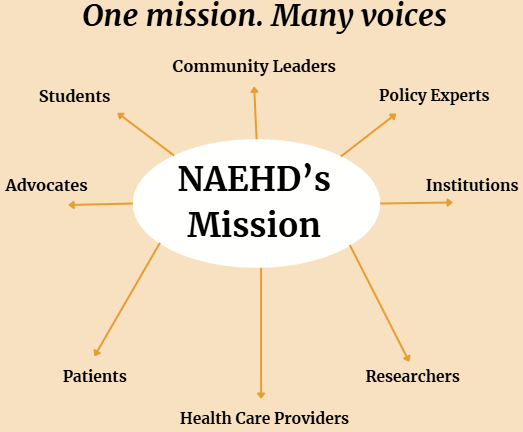
NAEHD’s mission is to end health disparities through research, education, and advocacy. This work is a collective effort that brings together individual and organizational members committed to advancing health equity.
Providers, patients, researchers, advocates, students, community leaders, and mission-aligned organizations each contribute lived experience and expertise. Together we form a movement rooted in equity, collaboration, and lasting impact.
What You Can Do
Share this page with those unfamiliar with health disparities who want to learn more. Raising awareness to this critical issue is the first step.
Join as a member to help amplify our mission to ending health disparities through research, education, and advocacy initiatives.
Follow and engage with NAEHD on social media to stay informed and help spread the message.
